A one-year-old car with 50,000 km on the clock and a price that looks too good usually has a simple explanation: it was a rental, a company fleet car or a government pool car. Here's how to tell, whether it's worth buying, and what to check before you bid at Pickles, Manheim or Grays.
Rental companies, fleet operators and government agencies buy new cars by the hundred, and they sell them the same way. Rental companies typically move their cars on after one to two years. Company cars on a lease commonly come back at around three years. When they do, they hit the used market in batches, often through an auction house or a dealer who bought a truckload at once. That volume, plus kilometres that are high for the car's age, is why these cars are usually priced below a privately owned equivalent.
It's also why buyers get nervous. Read any thread on Whirlpool or the Toyota Owners Club and the same worries come up. Dozens of drivers who didn't own the car and didn't care how they treated it. Nobody running the engine in gently. Car park dings fixed as cheaply as possible before the next hire.
The honest answer is that many of these cars are perfectly good: serviced on time, one registered owner, sensibly priced. Some aren't. The "ex-rental" label on its own doesn't tell you which one you're looking at. The car's history does.
How to tell a car was a rental
Sellers don't always mention it, and a second or third owner may not know. These are the tells to look for.
The first owner on the paperwork
Open the logbook or service book and look at the first owner and the first service stamp. A rental company (Hertz, Avis, Budget, Thrifty, Europcar, Sixt), a fleet leasing company or a finance company as the first owner is the clearest sign there is. So is a first service from a dealer next to a major airport, near Tullamarine, Mascot or Brisbane Airport. Check the owner's manual wallet too: a depot name, branch address or fleet number written inside is common.
Kilometres that are high for the car's age
Rental cars work hard, often 25,000 km a year or more. A one or two-year-old car with 40,000 to 60,000 km is a classic sign it spent its early life on hire. Ex-fleet company cars tend to come off lease at about three years with somewhere between 60,000 and 100,000 km.
The service history and the spec
Fleet cars are usually serviced right on schedule, but often at several different dealers, sometimes in different cities, as the car moved around the network. Look for base-spec trim in fleet colours like white or silver, and a scattering of small cosmetic repairs: a resprayed bumper, a replaced mirror, touched-up wheels.
What a MotorRegistry report shows
A MotorRegistry Comprehensive Plus report brings together the records that give a rental away, wherever they exist for the car:
- Past sales and auction listings. An earlier auction listing that described the car as "ex-rental", "ex-lease" or "fleet", or said it was "sold on behalf of" a company, settles the question.
- Registration history. Every plate and every state. Rental fleets move cars between states to follow demand, so a young car that has been registered in two or three states is worth a closer look.
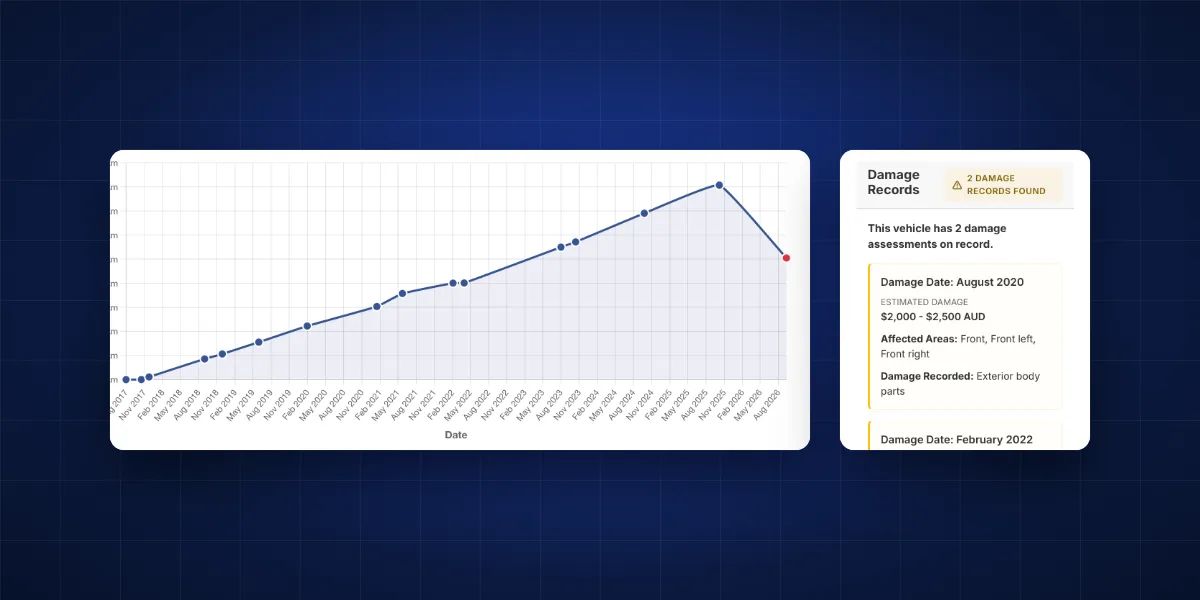
- Odometer readings over time. Kilometres piling up at rental pace in the first year or two show up clearly.
- Service records. Dealer services in different cities, on a strict schedule, fit the fleet pattern.
Finance still recorded on the PPSR
Rental and leasing companies, and the financiers behind them, register security interests on the PPSR over their fleet cars. That interest should have been released when the car was sold. If a finance check still shows one, don't pay a cent until it has been cleared in writing, because a registered security interest can follow the car to its next owner.
Are ex-rental, ex-fleet and ex-government cars worth buying?
Often, yes. But they come with a particular set of trade-offs, and it pays to know them before you fall for the price.
Why they're often good buys
- Serviced on schedule. Fleets service through dealer networks because skipping a service costs them warranty cover and resale value.
- Usually one registered owner. The company, not a string of private owners.
- Priced below private equivalents. The stigma and the kilometres knock the price down, sometimes by more than the car's condition justifies.
- Often still under new-car warranty. At one to three years old, many still have warranty left. Check the warranty booklet or ask a dealer, because some manufacturers set different warranty terms for cars used as rentals or in commercial service.
- Sensible models. Fleet buyers choose cars that are cheap to run and reliable, because breakdowns cost them money.
What to watch for
- Many drivers who didn't own it. Some will have driven it gently, some won't.
- High kilometres for the age. Tyres, brakes and suspension may be due sooner than you'd expect on a car this young.
- Cosmetic damage repaired cheaply. Fast, low-cost repairs between hires don't always match the original paint or fit.
- Minor accidents that never reached the write-off register. A crash only goes on the register if the car is written off. Plenty of repaired damage never does.
- Base spec. Fewer features than the private car you're comparing it with, so compare like for like on price.
- Decal ghosting. Ex-government and some ex-fleet cars can show faint outlines where signage or stickers were removed.
A short verdict on each
- Ex-rental: usually mechanically sound and serviced on time, but expect high kilometres and some cosmetic wear. The history decides it: look for damage records and odometer readings that add up.
- Ex-fleet: often a good middle ground. Usually one driver or a small pool, serviced on schedule, with kilometres that reflect commuting and work trips. Work utes can have had a harder life than sedans and hatches.
- Ex-government: usually the gentlest of the three. Pool cars tend to be serviced strictly to schedule and driven on routine trips, though some agencies run their cars hard, so check rather than assume.
An "ex-rental" label doesn't tell you whether a car is good or bad. Its history does.
Buying at auction: Pickles, Manheim and Grays
Many of these cars are sold through the big auction houses, and that's where some of the best prices are. But the rules at auction are tougher on the buyer than at a dealer or a private sale.
- No cooling-off period and generally no statutory warranty. Auction cars are sold as is. If you change your mind or find a fault the next day, that's generally your problem.
- The hammer price isn't the price. A buyer's premium and other fees are added on top. They vary by auction house and by lot, so read the conditions of sale before you register to bid.
- No test drives. You usually can't drive the car before you buy it. Read the condition report twice, and go to the viewing day to inspect it in person.
- The lot description tells you who is selling. Fleet, rental, government, an insurer selling salvage, or a repairable write-off are all very different cars, even if the photos look similar.
- Some lots are unregistered. Budget for a roadworthy or safety certificate (the name depends on your state) plus registration.
- Budget for a mechanic. Assume the car will need something, and set money aside for it.
Once the hammer falls, you own it. Every check has to happen before you bid, not after.
Before you bid
- Get the VIN or rego from the listing. Most auction listings show one or both; if not, ask.
- Run a vehicle history check on it.
- Read the condition report, then read it again.
- Inspect the car in person on the viewing day, or send someone who knows cars.
- Check the PPSR for finance still owing.
- Check written-off status and any damage records, including repairs that never reached the write-off register.
- Compare the odometer on the dash with the readings on record.
- Check the service records against the manufacturer's schedule.
- Work out the all-in price: hammer price, buyer's premium and fees, transport, and registration and a roadworthy if the car is unregistered.
- Set a walk-away price, and stick to it when the bidding gets exciting.
What a Comprehensive Plus report shows on these cars
A Comprehensive Plus report answers most of the questions above in one place, wherever the records exist for the car:
- Past sales and auction listings. How the car was advertised last time, with the photos, the kilometres and the asking price. If it was listed as ex-rental or fleet, you'll see it.
- Registration history. Every plate and every state, so interstate moves are visible.
- Odometer history. Does 25,000 km a year add up for this car? Any reading that goes backwards is flagged. See our odometer history check page.
- Service and maintenance records. Whether the fleet actually kept to the schedule. See our vehicle service history report page.
- Damage assessments. Including repairs that never reached the written-off register.
- The official PPSR certificate. Finance owing, written-off and stolen status, with a free 14-day finance re-check so you'll know if anything changes before you pay. See our vehicle finance check page.
If you're weighing up providers, our comparison page sets out what each report includes.
Quick answers
How can I tell if a car was a rental? Look at the first owner and first service in the logbook, the kilometres for the car's age, and whether it's a base model in white or silver. A vehicle history report that shows past auction listings and registration history usually settles it.
Are ex-rental cars bad? Not usually. Most are serviced on schedule and priced below private equivalents. The risks are high kilometres, cheap cosmetic repairs and minor damage, so check the history before you buy.
Do auction cars come with a warranty or cooling-off period? No cooling-off period, and generally no statutory warranty. Auction cars are sold as is, although a car may still have some of the manufacturer's new-car warranty left.
What fees do I pay on top of the hammer price? A buyer's premium and other fees, which vary by auction house and by lot. Read the conditions of sale, and add transport, registration and a roadworthy if the car is unregistered.
Is an ex-government car a good buy? Usually. Government pool cars tend to be serviced strictly to schedule and driven on routine trips, but some agencies run their cars hard, so check the history like any other car.
Before you bid or pay
Ex-rental, ex-fleet and ex-government cars can be some of the best value on the used market. The ones to avoid are the ones whose story doesn't add up. Run the check on the rego or VIN before you bid or hand over any money, and if the history and the price don't match, walk away.